

Events
June 2026 Workshop
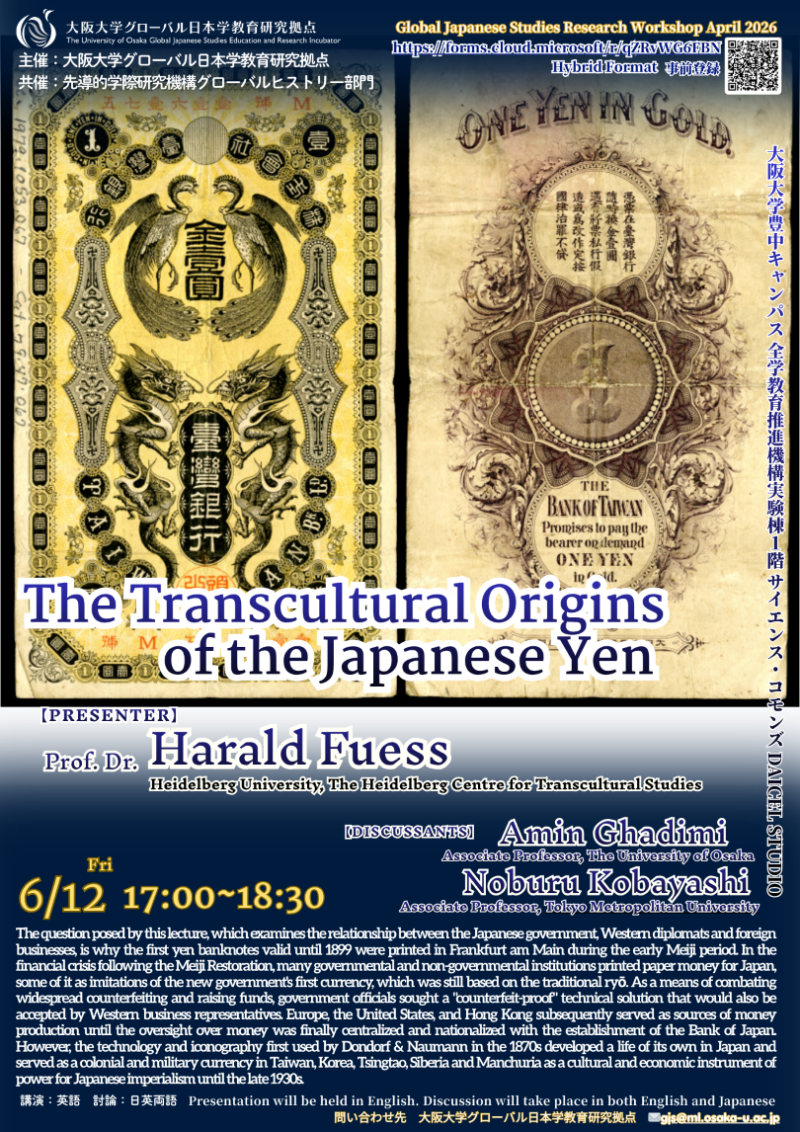
The Transcultural Origins of the Japanese Yen
Time: Friday, June 12, 2026, from 5:00 PM to 6:30 PM (JST)
Venue: DAICEL Studio, 1st floor of Science Commons Bld. (Center for Education in Liberal Arts and Sciences), Osaka University Toyonaka Campus (and online via Zoom)
Languages: Presentation will be in English.
Registration: Please register from the URL or QR code on the flyer.
https://forms.cloud.microsoft/r/qZRvWG6FBN
【Presenter】
Professor Dr. Harald Fuess(Heidelberg University, The Heidelberg Centre for Transcultural Studies)
【Disscussants】
Amin Ghadimi (Associate Professor, Osaka University)
Noburu Kobayashi (Associate Professor, Tokyo Metropolitan University)
【Summary】
The question posed by this lecture, which examines the relationship between the Japanese government, Western diplomats and foreign businesses, is why the first yen banknotes valid until 1899 were printed in Frankfurt am Main during the early Meiji period. In the financial crisis following the Meiji Restoration, many governmental and non-governmental institutions printed paper money for Japan, some of it as imitations of the new government’s first currency, which was still based on the traditional ryō. As a means of combating widespread counterfeiting and raising funds, government officials sought a “counterfeit-proof” technical solution that would also be accepted by Western business representatives. Europe, the United States, and Hong Kong subsequently served as sources of money production until the oversight over money was finally centralized and nationalized with the establishment of the Bank of Japan. However, the technology and iconography first used by Dondorf & Naumann in the 1870s developed a life of its own in Japan and served as a colonial and military currency in Taiwan, Korea, Tsingtao, Siberia and Manchuria as a cultural and economic instrument of power for Japanese imperialism until the late 1930s.