
イベント
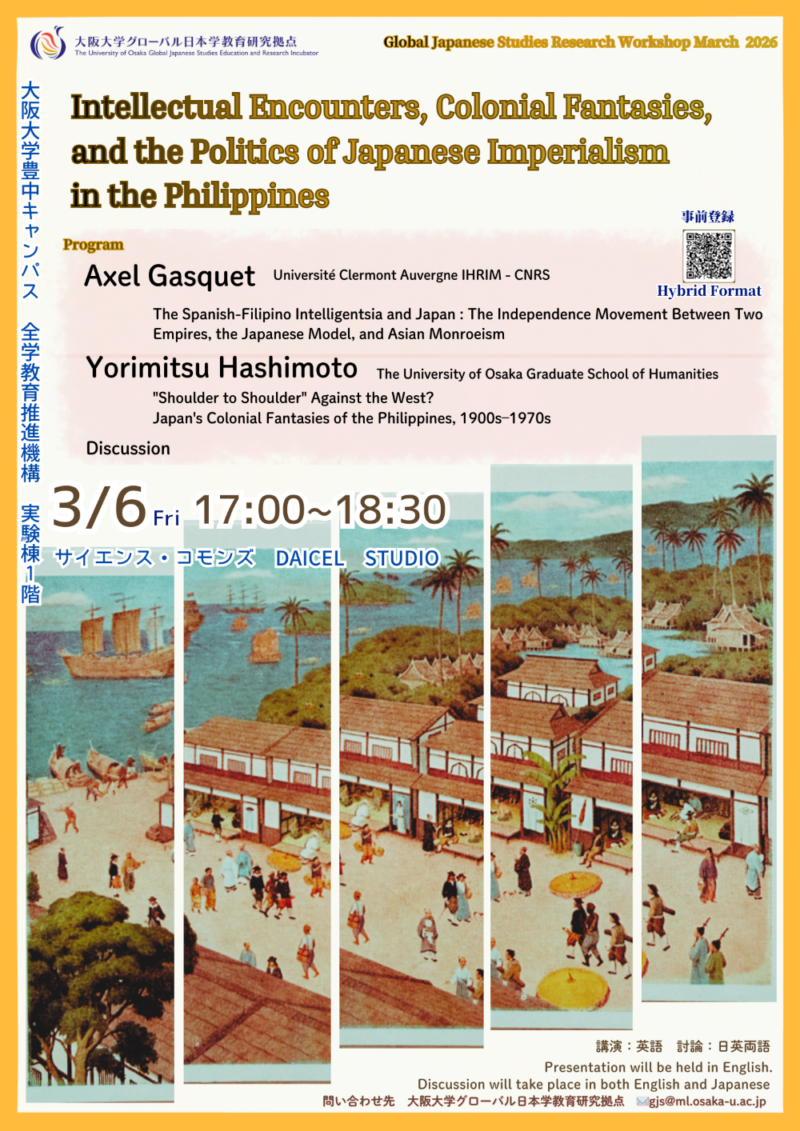
GJS Research Workshop 2026年3月例会
Intellectual Encounters, Colonial Fantasies, and the Politics of Japanese Imperialism in the Philippines
日 時:2026年3月6日(金)17:00~18:30
会 場:大阪大学豊中キャンパス 全学教育推進機構 実験棟1F サイエンス・コモンズ DAICEL Studio(ハイブリッド開催)
開催言語:英語
参加登録:https://forms.office.com/r/M7Wfk7JAef
【登壇者】
Axel Gasquet (Université Clermont Auvergne IHRIM – CNRS)
Yorimitsu Hashimoto (The University of Osaka Graduate School of Humanities)
【趣旨】
Axel Gasquet (Université Clermont Auvergne IHRIM – CNRS)
The Spanish-Filipino Intelligentsia and Japan : The Independence Movement Between Two Empires, the Japanese Model, and Asian Monroeism
The first Filipino-Spanish independence movement, belonging to the so-called “Ilustrados” generation (1872-1898), culminated with the end of Spanish sovereignty in the archipelago. The American administration in the Philippines (1898-1942, 1945-1946) did not extinguish the flame of independence within society. The Filipino elite followed the progress of Japanese modernization with interest. Japan was seen as an exemplary model of modern Asian development, influencing notable Filipino intellectuals (José Rizal, Theodore Kalaw, Jesús Balmori, etc.). This dynamic shifted with the Japanese invasion of the Philippines in December 1941. Japanese expansionism was a corollary of the “Asian Monroeism” practiced by the Mikado under the term “coprosperity.” In 1927, an intense public debate took place between Claro Mayo Recto and Theodore Kalaw regarding the relevance of this concept. The invasion revealed that “shared prosperity” was a misuse of language and a fallacy. The Philippines was forced to supply the Japanese empire with raw materials and foodstuffs, especially rice, at a loss.
The Japanese established the Second Philippine Republic, whose president, lawyer José P. Laurel, had studied in Tokyo. This puppet government had a threefold mission: to suppress and channel the growing independence movement; to ensure the Philippines’ economic subservience to the Japanese imperial project; and to create a smokescreen between the occupier and the Filipinos. Veteran independence general Artemio Ricarte, exiled in Japan since 1901, acted as a propaganda agent for Laurel. When MacArthur launched the reconquest of Leyte in October 1944, Ricarte led a pro-Japanese militia and fought against the Allies. The postwar period brought disgrace upon José P. Laurel and the collaborators of the Japanese regime, who began a political reconversion after independence in 1946, seeking justifications for their previous alignment with the Mikado. Our presentation will recount the political and social coordinates of this period, examining the reasons for the initial attraction and subsequent rejection of the Japanese model among the Philippine elites.
Yorimitsu Hashimoto (The University of Osaka Graduate School of Humanities)
“Shoulder to Shoulder” Against the West? Japan’s Colonial Fantasies of the Philippines, 1900s–1970s
This presentation examines how Japanese Pan-Asian ideologies were constructed through narratives of solidarity centered on the Philippines. From the late nineteenth century, Japanese writers imagined Japan as an ally of “South Seas” peoples resisting Western colonial rule—a self-justifying discourse masking Japan’s own imperial ambitions. The analysis traces how Japanese intellectuals, responding to Western gunboat diplomacy, sought to “revive” maritime traditions and empire under slogans like “Asia for the Asiatics” and the “Asiatic Monroe Doctrine.” Crucially, this project involved historical revisionism, in which the wakō (multinational pirates across the early modern China Sea) were reimagined as Japanese merchant-adventurers and imperial precursors. Scholarship on “Japanese towns” allegedly established by these merchants, combined with popular fiction, retroactively legitimized Japan’s regional presence and hegemony.
The presentation centers on three key texts. Oshikawa Shunrō’s widely read Pan-Asianist novel series, beginning with Bukyō no Nihon (The Chivalrous Japan, 1902), features Japanese warriors aiding Filipino independence leader Emilio Aguinaldo against American rule. Inspired by the 1899 Nunobiki-maru incident—an alleged arms-delivery vessel for Aguinaldo—the novels offered a fantasy of Japanese–Filipino cooperation. Writer Kimura Ki, captivated by these fictions, visited the occupied Philippines in 1942 and attempted to synchronize Oshikawa’s narrative with historical fact, presenting the novels to Aguinaldo himself.
Finally, the 1978 television drama Ōgon no Hibi (Golden Days) features the legendary merchant Luzon Sukezaemon fighting alongside Filipinos against Western “pirates” in the sixteenth century. While reproducing familiar Asianist tropes, this drama complicates them by foregrounding Filipino distrust and Japanese violence, notably through the incorporation of the banned song “Bayan Ko,” which Filipino actors performed while likely concealing its political resonance. Collectively, these texts reveal how Japanese colonial fantasies functioned as ventriloquism that sought to make Filipino voices speak Japan’s imperial narrative, yet the strings occasionally slipped—allowing those voices to exceed their scripted roles and expose the violence underlying these fantasies.