
コラム
Connecting Interdisciplinary Communities: Teaching and Research of International Japanese Studies in Japan
Gloria Yu YANG
Lecturer, Kyushu University Faculty of Humanities
Why do people study Japan in Japan using English?
I get this question often, especially when I mention that I teach modern Japanese art in English at Kyushu University. Interestingly, I received similar questions when I was a PhD student in the US doing dissertation research on Japan fifteen years ago: If you are studying Japan, why not do so in Japan?
I have never had a quick, simple answer. Over the past fifteen years, however, the landscape surrounding these questions has changed. Japanese universities have experienced a wave of internationalization (国際化 kokusai-ka). Government initiatives have encouraged universities to establish International Japanese Studies programs, hire foreign faculty, conduct international collaborative research projects (国際共同研究 kokusai kyōdō kenkyū), and promote the production of scholarly publication and conference presentations in English. As a result, kokusai-ka has become an almost cliché, fashionable umbrella term that frequently appears in discussions about the future of higher education in Japan.
The International Master’s Program (IMAP) in Japanese Studies at Kyushu University was established in 2011 as a highlight of the university’s broader commitment to internationalization. An accompanying International Doctorate (IDOC) was introduced in 2017. A major turning point for the program came in 2018, when the number of faculty members increased significantly. Today, the program includes five non-Japanese, full-time faculty members specializing in Japanese art history, visual culture, literature, religion, and history. Within Kyushu University, the IMAP/IDOC programs are known collectively as Kōjinbungaku (広人文学, “the broad study of [Japanese] humanities”) and are an integral component of the Faculty of Humanities.
The IMAP/IDOC curriculum is designed to integrate the strengths of graduate education in the US, Japan, and Europe. Its structure follows the model of American (and partially European) graduate programs, including methodology seminars, survey courses, in tensive reading workshops, and discussion-driven seminars. The program maintains a notably high faculty-to-student ratio, enabling individualized mentorship and a highly research-oriented environment.
A distinctive component of the IMAP/IDOC curriculum is its one-week in situ fieldwork trip in Japan. Faculty members collaborate in planning and leading the trip, and students contribute ideas for sites related to their individual research. The fieldwork functions as an intensive research seminar—with preparatory discussions, onsite presentations, and the production of follow-up journals and papers—as well as an important bonding experience, as students spend days and nights working and living together. In 2025, the group traveled to the Seto Inland Sea for the Setouchi Triennial 2025 and to Nara for the annual Shōsōin exhibition, engaging in firsthand dialogues with artworks and local communities.
The success of the program owes much to the faculty’s shared ideals and collaborative efforts. The five faculty members collaborate with one another, as well as with Japanese colleagues and international scholars. They publish in English, Japanese, and Chinese, and participate actively in both domestic and international research projects, from Kaken grants in Japan to Getty Foundation Initiatives in the United States. The program regularly invites scholars to deliver guest lectures in both English and Japanese. As a result, the IMAP/ IDOC student body is a dynamic, diverse community of master’s, doctoral, exchange, and research students from around the world. The central hub of the community is the Japanese-style “KKS” (研究室 kenkyūshitsu), a room serving as an internal library and common space.
Of course, there are great challenges for IMAP/ IDOC as a graduate program in Japanese Studies taught in English. The most immediate is the language barrier: the necessity of the ability to read in Japanese and engage meaningfully with Japanese-language scholarship. Since IMAP/IDOC does not offer its own Japanese-language courses, students must rely on self-directed study, which becomes a major test of time management and discipline, especially given the standard course load of four to five seminars per semester. I try to incorporate Japanese scholarship whenever possible in my own teaching, but students often struggle to keep pace. Intensive reading in English each week is already demanding; adding a comparable volume of Japanese material can easily become overwhelming.
A deeper challenge lies in understanding Japanese scholarship itself and bringing it into productive dialogue with English-language scholarship. Academic traditions and disciplinary structures in Japan—root ed in shared understandings, theoretical frameworks, scholarly lineage and audiences—have developed differently from those in the US and Europe. For example, scholarly “lineage” and generational knowledge trans mitted through enclosed groups and mentorship, such as kenkyūshistu, kenkyūkai (研究会), and institutional histories, play a crucial role in shaping the state of the field.
I recognize my students’ struggles to balance and bridge these two scholarly worlds because of my similar experiences: I studied Japanese art history in the United States and wrote my doctoral thesis on Japanese colonial architecture, but for my dissertation research in Japan I was affiliated with an architecture department, part of an engineering program (工学 kōgaku) grounded in completely different methodologies, focuses, and academic communities. It requires tremendous effort and time to understand and navigate between the Japanese-language and English-language scholarly worlds. As a result, working across them can sometimes feel like standing between two walls—like a stray cat unsure of where it belongs. I find helping students recognize, engage with, and eventually participate in both scholarly communities remains one of the most complex and persistent challenges of this work.
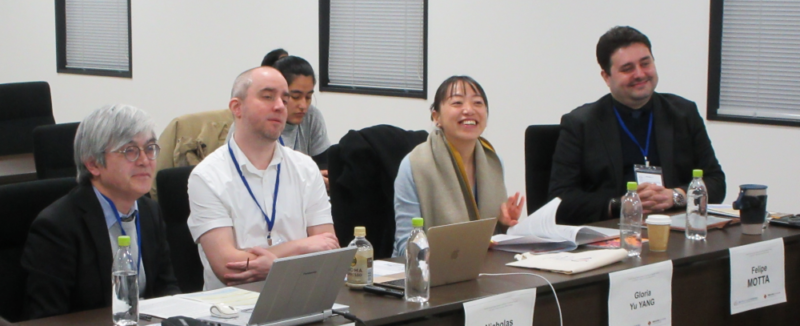
It was an unexpected and inspiring trip to Osaka on a deep winter day. I participated as a discussant at the Seventh Annual Osaka Graduate Conference in Japanese Studies, held at Osaka University’s Minoh Campus on January 25, 2025. To my surprise, I felt energized after a full day of listening to presentations by nine graduate students from universities across Japan and discussing their work alongside fellow discussants (Akiyama Kaori, Shōya Unoda, and Nicholas Lambrecht of the University of Osaka and Felipe Motta of Kyoto University of Foreign Studies) and other attendees. I was deeply impressed by the students’ craft of research— their bilingual or even trilingual abilities, their thorough analyses of Japanese primary sources, and their engagement with both Japanese- and English-language scholarship. I was also inspired by the discussants’ warm and insightful feedback. The excitement and sense of inspiration lasted long after the one-day conference.
In many ways, this experience spoke to the struggles and difficulties I have encountered in my own path. As the presenters at the conference demonstrated, solid training in Japanese primary materials and academic discourses, combined with an ability to engage with broader scholarly conversations in English, will cultivate a new generation of scholars with balanced, multilingual intellectual mindsets. The discussions also highlighted that interdisciplinary research is a great strength of International Japan Studies, as it fosters new perspectives and broadens the horizons of current scholarship.
Furthermore, what struck me most was how the conference instilled in me a sense of hope that collaborations on International Japanese Studies in Japan among the University of Osaka, Kyushu University, and other institutions will help the field gain further recognition and thus shape its future. Gatherings like this help cultivate a connected community that can make kokusai-ka a concrete reality—through conferences, workshops, and inter-university collaboration. This is both exciting and genuinely encouraging.
As I write this essay, I still remember the supportive atmosphere and inspiring discussions at the conference. The two questions asked at the opening still do not have easy answers, but what matters is that in the process of building and developing International Japanese Studies, we share and connect with other scholars who have similar mindsets and visions.